
1. Basic Definition and Core Composition
Bearing steel, also known as high-carbon chromium steel, follows strict compositional standards: carbon content Wc is approximately 1%, while chromium content Wcr ranges from 0.5% to 1.65%. As a key material for producing bearing components, this alloy delivers outstanding hardness, wear resistance, and hardenability, making it widely applied in various types of machinery.
2. Two Core Classification Methods of Bearing Steel
2.1 Classification by Variety
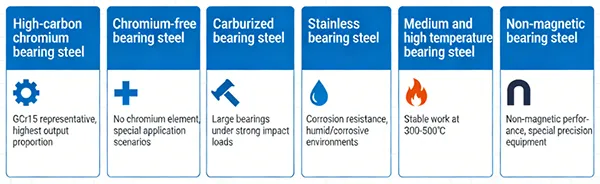
Based on chemical makeup, performance, and intended use, bearing steel is mainly divided into six categories to meet different industrial requirements:
- High-carbon chromium type: The most widely used grade, represented by GCr15, with an extremely high production share.
- Chromium-free type: Formulated without chromium elements, designed for specialized applications.
- Carburized type: Used in heavy-duty bearings that withstand strong impact loads.
- Stainless type: Features corrosion resistance, ideal for humid and aggressive environments.
- Medium and high-temperature type: Ensures stable performance under operating temperatures of 300~500℃.
- Non-magnetic type: Provides non-magnetic properties, suitable for precision equipment.
2.2 Classification by Performance and Application
Grouped by chemistry, processing techniques, and service conditions, bearing steel can also be sorted into four major types with distinct characteristics:
- Through-hardened: Primarily high-carbon chromium alloy (such as GCr15, GCr15SiMn), with about 1% carbon and 1.5% chromium. Silicon, manganese, and molybdenum are often added to enhance performance. It accounts for over 95% of total output and enjoys the broadest application.
- Carburized: Low-carbon alloy with 0.08~0.23% carbon, belonging to chromium-nickel-molybdenum structural steels. Parts undergo carbonitriding to improve surface hardness and wear resistance. Commonly used in heavy-duty bearings for rolling mills, automobiles, mining machinery, and rail vehicles.
- Stainless: Split into high-carbon grades (such as 9Cr18, 9Cr18MoV) and medium-carbon grades (such as 4Cr13). Its main advantage is rust and corrosion resistance in harsh environments.
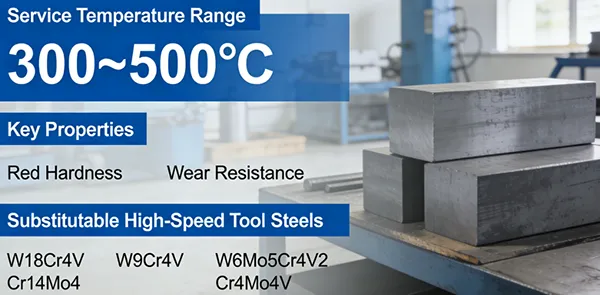
- High-temperature: Designed for service at 300~500℃, requiring red hardness and wear resistance. It is often substituted with high-speed tool steels including W18Cr4V, W9Cr4V, W6Mo5Cr4V2, Cr14Mo4, and Cr4Mo4V.
3. Core Variety: In-depth Explanation of High-Carbon Chromium Grade GCr15
3.1 Basic Characteristics of GCr15
GCr15 is the most widely produced grade of bearing steel in the world. Since its introduction in 1901, its main chemical composition has remained stable, with about 1% carbon and 1.5% chromium. It represents more than 80% of global production. In industrial practice, if not otherwise specified, this grade is the default reference.
3.2 Implementation Standards
Production of the GCr15 grade follows two major standards, with the customized protocol offering stricter requirements:
- National standard: GB/T 18254-2002, the fundamental industry specification.
- Special quality protocol: Laigang GCr15JD, developed for precision forging customers. It imposes tighter controls including oxygen content ≤10ppm, central segregation grade ≤1.0, and higher requirements in composition control, fixed length and dimensional deviation.