
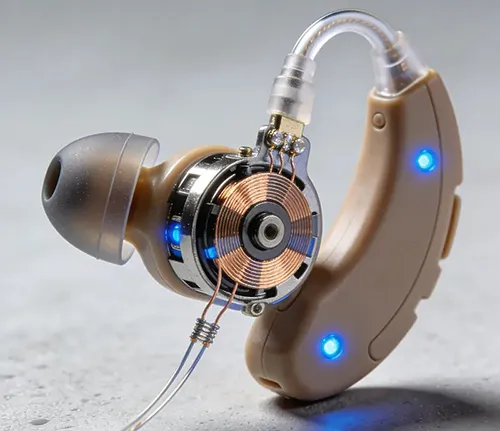
hearing aids have extremely high requirements for dimensional accuracy, surface quality, and biocompatibility in their core components (such as the shell, sound tube, connector, and internal transmission gears). Numerical control machining (CNC machining), with its advantages of micron-level precision control, strong batch consistency, and high adaptability to complex structures, has become the core technology for hearing aid component manufacturing.
I. Core CNC-Machined Components of Hearing Aids and Their Characteristics
Hearing aid components typically feature miniaturization, thin-walled design, and irregular shapes. The processing focus differs significantly between different components, as detailed below:
| Part type | Functions and uses | |
| Custom ear canal shell | Fits snugly in the ear canal and protects internal components. | Dimensional tolerance ±0.005mm (fits the ear canal contour); 2. Surface roughness Ra≤0.8μm (avoids ear canal irritation); 3. Thin-walled (0.15-0.3mm) with no deformation. |
| Acoustic conduit / sound cavity | Conducting sound and controlling acoustic properties | 1.Inner hole roundness ≤ 0.002mm (reduce sound loss); 2. Axis straightness ≤ 0.003mm; 3. No burrs/flashes (avoid blocking the sound channel) |
| Internal precision gears | Adjust volume, switch programs | 1.Tooth profile accuracy ISO 5 or higher; 2. Extremely small module (typically 0.1-0.3mm); 3. Hardness meets requirements (to prevent wear). |
| Electrode connector | Connecting the battery/chip and transmitting signals. | 1.Pinhole coaxiality ≤ 0.004mm; 2.Contact surface flatness ≤ 0.002mm; 3.Corrosion resistance (requirements for medical coatings) |
II. Core Advantages of CNC Machining in Hearing Aid Component Manufacturing
Compared to traditional machining methods (such as injection molding and laser cutting), CNC machining offers irreplaceable advantages in hearing aid component manufacturing:
Ultra-high precision, meeting miniaturization requirements:
Hearing aid components are typically millimeter- or even sub-millimeter-sized (e.g., the inner diameter of the acoustic duct is only 1-2 mm). CNC machining, through high-speed spindles (10,000-60,000 rpm) and precision servo systems, can achieve positioning accuracy of ±0.001 mm, meeting the stringent requirements of acoustic performance for dimensional errors (e.g., a deviation of 0.01 mm in the acoustic cavity size can lead to sound distortion).
Capability to process complex and irregular structures:
Custom ear canal shells require machining “asymmetric curved surfaces + internal cavities” based on the user’s ear mold data. CNC milling (especially five-axis CNC) can complete the machining of complex contours in one go through multi-dimensional linkage, avoiding the accumulation of errors caused by multiple clamping operations, while ensuring the fit between the ear shell and the ear canal (crucial for wearing comfort).
Machining Capabilities for Complex and Irregular Structures:
Custom ear canal shells require machining an “asymmetric curved surface + internal cavity” structure based on the user’s earmold data. Multi-material compatibility and biocompatibility of it’s components are crucial. These components must simultaneously meet requirements for “biocompatibility,” “lightweight design,” and “acoustic performance.” CNC machining can process various medical-grade materials without affecting their performance:
Metallic Materials:
Titanium alloy (lightweight, corrosion-resistant, used for high-end shells/connectors), medical-grade stainless steel (high strength, used for internal support);
Non-metallic Materials:
Medical-grade ABS (low cost, easy to machine, used for basic shells), PEEK (high temperature resistance, good biocompatibility, used for implantable it’s components).
Batch consistency and traceability are critical for medical devices. “Batch variation” must be strictly controlled. Through standardized programming and automated tooling fixtures, CNC machining can achieve dimensional deviations of ≤0.003mm for hundreds of parts in a single batch. Meanwhile, machining parameters (such as cutting speed and feed rate) can be recorded in real time, meeting the requirement of “full-process traceability” for medical devices (compliant with ISO 13485 standard).
III. Key Technical Requirements for CNC Machining of Hearing Aid Components
Hearing aids are classified as Class II medical devices. The machining of their components must simultaneously meet three dimensions: “precision standards,” “material standards,” and “compliance standards.” Specific requirements are as follows:
1.Precision and Surface Quality Control
Dimensional Tolerances: The tolerances of core components (e.g., connector pinholes) must be controlled within the range of ±0.002-±0.005mm, significantly higher than the tolerances of ordinary mechanical parts (±0.01mm);
Geometric Accuracy: Flatness ≤0.002mm/100mm, coaxiality ≤0.003mm (to avoid sound reflections caused by acoustic tube eccentricity);
Surface Treatment: Metal parts must undergo passivation treatment (to improve corrosion resistance), and non-metallic parts must undergo mirror polishing (Ra≤0.4μm), and no cutting fluid/impurities should remain (to avoid skin irritation or affecting acoustic performance).
2.Material and Biocompatibility Requirements
All processed materials must meet medical-grade standards, specifically as follows:
Metallic materials: Must pass the “Cytotoxicity Test” (ISO 10993-5) to prevent the leaching of heavy metals such as nickel and chromium;
Non-metallic materials: Must pass the “Skin Irritation Test” (ISO 10993-10) and possess good anti-aging properties (service life ≥ 5 years, preventing material deformation after long-term wear).
3.Compliance and Quality Management
CNC machining processes must strictly adhere to medical device industry standards. Core compliance requirements include:
System Certification: Processing companies must be certified to the ISO 13485 Medical Device Quality Management System;
Product Certification: Components must comply with regional regulations (e.g., China’s National Medical Products Administration (NMPA), the US Food and Drug Administration (FDA), and the EU CE MDR), and provide a “Process Validation Report” and a “Material Traceability Certificate.”
Cleaning and disinfection: After processing, the parts must undergo “ultrasonic cleaning (to remove cutting debris) + ethylene oxide disinfection (compliant with ISO 11135 standard)” to ensure a sterile condition (especially for shell parts that come into contact with the skin).
Aluminum Alloy Machining CNC machining Hearing aid parts Medical parts processing Medical Screw Machining pacemaker Rolling Bearing Semiconductor components Shaft Core slip ring Stainless Steel