
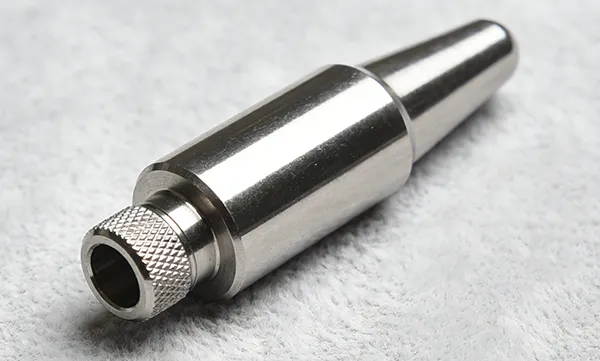
The precision shaft core is the core transmission component of hemostatic forceps,which directly determines the opening and closing flexibility and service life of the instrument.Processing of precision shaft core for hemostatic forceps requires extremely high dimensional accuracy,geometric tolerance and surface quality,adapting to the strict medical standards of burr-free,corrosion resistance and biocompatibility.The following briefly disassembles the process and core difficulties of medical precision shaft core processing.
I.Processing Flow of Precision Shaft Core for Hemostatic Forceps(Core Processes)
The precision shaft core for hemostatic forceps is mostly a stepped shaft(diameter 2-8mm,length 10-30mm),commonly made of 304/316 stainless steel,40Cr alloy steel or titanium alloy.Processing of precision shaft core for hemostatic forceps follows a closed loop of”material selection and pretreatment→datum positioning→phased cutting→heat treatment strengthening→finishing and polishing→inspection and acceptance”,with strict error control in each process:
1.Material Selection and Pretreatment
Medical-grade high-purity 304/316 stainless steel is preferred,with strict control of material inclusion grade;40Cr alloy steel is selected for high strength requirements,and titanium alloy is used for high-end minimally invasive models.The blank is cold-drawn or die-forged for pretreatment,followed by normalizing to eliminate internal stress and improve cutting performance.Ultrasonic testing(UT)is performed before rough machining to check for internal defects.
2.Datum Positioning
The central holes at both ends are used as the core datum.Type B central holes are drilled and lapped,with roundness controlled within≤0.003mm;”dead center+live center”combined with hydraulic expansion mandrel is adopted for subsequent turning and grinding to ensure clamping accuracy≤0.003mm and avoid clamping deformation.
3.Phased Cutting Processing
It is carried out in three steps:”rough machining→semi-finishing→finishing”,preferably using CNC sliding head lathes and precision CNC lathes:rough machining quickly forms the shape and reserves allowance;semi-finishing finishes the contour and controls the tolerance to IT10-IT9;finishing uses diamond/CBN tools,and finally controls the key dimensional tolerance to IT6-IT5,coaxiality≤0.005mm,and surface roughness Ra≤0.4μm.
4.Heat Treatment Strengthening
Stainless steel shaft cores adopt solution treatment,alloy steel shaft cores adopt quenching and tempering+high-frequency quenching,and high-end shaft cores add deep cryogenic treatment.The core is to improve hardness,toughness and wear resistance,and strictly control heat treatment parameters to avoid deformation affecting accuracy.
5.Finishing,Polishing and Surface Treatment
The surface roughness is reduced to Ra≤0.1μm by superfinishing and honing to remove burrs;stainless steel is passivated and titanium alloy is anodized to ensure corrosion resistance and biocompatibility,meeting medical standards.
6.Inspection and Acceptance
An”online inspection+final inspection”mode is adopted:online real-time monitoring is performed with laser diameter gauges and roundness meters;final inspection is full-size verified with coordinate measuring machines(CMM),combined with surface profilometers and magnetic particle testing(MT)to ensure all indicators meet medical standards,and unqualified products are directly scrapped.
II.Core Processing Difficulties of Precision Shaft Core for Hemostatic Forceps
The difficulty of processing precision shaft core for hemostatic forceps is much higher than that of ordinary shaft parts,focusing on five core aspects,which are consistent with its small,precise and medical characteristics,and also the core pain points of medical precision shaft core processing:
1.Difficult Control of Dimensional and Geometric Tolerances
The key dimensional tolerance reaches IT5-IT6 grade,with diameter error≤±0.008mm and coaxiality≤0.005mm.It is necessary to frequently calibrate tools,strictly control cutting temperature and central hole accuracy,and avoid cumulative errors and step surface perpendicularity deviations.
2.Great Difficulty in Deformation Prevention and Contro
The shaft core is small,and improper clamping force,cutting stress and heat treatment parameters can all lead to irreversible deformation.It is necessary to accurately control clamping force,perform phased cutting to release stress,and strictly control heat treatment and straightening accuracy.
3.Difficult Guarantee of Surface Quality
It needs to meet the medical requirements of burr-free,scratch-free and corrosion resistance.Materials are prone to tool adhesion and built-up edge;polishing needs to balance accuracy and smoothness;surface treatment needs to strictly control parameters to eliminate harmful substance residues.
4.Difficult Processing of Small Features
Small features such as keyways and pin holes are extremely small,with poor tool rigidity and easy breakage,and drilling is prone to deflection.Special micro-tools and precise positioning are required to ensure that the feature size and position accuracy meet the standards.
5.Difficult Control of Batch Consistency
Batch production requires ensuring dimensional deviation≤±0.005mm.Material batches,tool wear,ambient temperature,etc.,can all affect consistency.It is necessary to adjust cutting parameters,equip tool wear compensation systems,and process in a constant temperature and vibration-isolated workshop.
III.Difficulty Summary
Processing of precision shaft core for hemostatic forceps requires the coordination of materials,processes,equipment,inspection and environment.The core difficulties are precision control and deformation prevention and control,which are also the key bottlenecks of medical precision shaft core processing.It has extremely high requirements for equipment,tools,operators and inspection methods.Any deviation in any link will lead to scrapping,and the processing threshold is significantly higher than that of ordinary precision shaft parts.