
Thin-wall bearing machining involves three key phases: roughing, semi-finishing, and precision finishing. First, the majority of the metal allowance is removed through synchronized cutting and reverse-cutting actions. As the process continues, the cutting pressure is eased to create a subtle matte finish. In the final stage, an oil film isolation technique is applied to ensure a flawlessly smooth, bright, and mark-free surface.
1. Machining Sequence
(1) Cutting of Thin-Wall Bearings
When the surface of the grindstone contacts the peaks on the rough raceway surface, the contact area is small and the force per unit area is large. Under a certain pressure, the grindstone is first subjected to “reverse cutting” by the bearing workpiece, causing some abrasive grains on the grindstone surface to fall off and fracture, gradually exposing new sharp abrasive grains and cutting edges.
At the same time, the surface peaks of the bearing workpiece are rapidly cut. Through cutting and reverse cutting, the surface peaks and the grinding-affected layer of the thin-wall bearing workpiece are removed. This stage is called the cutting stage, in which most of the metal allowance is removed.
(2) Semi-Cutting of Bearings
As machining continues, the surface of the thin-wall bearing workpiece is gradually flattened. At this time, the contact area between the grindstone and the workpiece surface increases, the pressure per unit area decreases, the cutting depth is gradually reduced, and the cutting capacity is weakened simultaneously.
In addition, the pores on the grindstone surface are blocked, and the grindstone is in a semi-cutting state. In the semi-cutting stage, the cutting marks on the bearing workpiece surface become shallow and a dull luster appears.
(3) Finishing Stage
This stage is a step in the superfinishing of bearings. As the workpiece surface is gradually flattened, the contact area between the grindstone and the workpiece surface further increases, and the grindstone and the thin-wall bearing workpiece surface are gradually isolated by a lubricating oil film.
Thus, the pressure per unit area is very small, the cutting effect is reduced, and cutting stops automatically. In the finishing stage, there are no cutting marks on the workpiece surface, and the bearing presents a bright finished luster.
2. Machining Difficulties
(1) Forging Process
For large-size and small aspect ratio thin-wall bearing rings, two or more rings are forged together. After rough grinding, the rings are separated by wire cutting to reduce the forging difficulty, minimize ring deformation and end-face machining allowance, save raw materials, and improve production efficiency.
(2) Turning Process
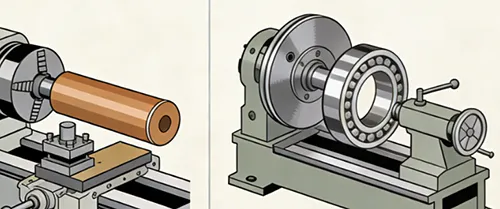
Machining accuracy is mainly affected by clamping, excessive cutting force, unreasonable fixture design, cutting thermal deformation, and vibration during cutting.
To reduce deformation caused by excessive turning stress, unhardened steel soft jaws with a large enveloping contact area are used to clamp the rings for rough turning, such as 12-point or 24-point multi-jaw chucks.
The clamping method is changed from radial clamping to end-face clamping. Process parameters are adjusted, including high-speed cutting, small depth of cut, large major cutting edge angle, small tool nose radius, and proper cutting fluid selection.
An additional tempering is performed after rough turning to relieve stress, followed by soft grinding of the end faces and then finish turning of the rings.
(3) Heat Treatment
During heat treatment, phase transformation occurs inside the ring: austenite transforms into martensite, leading to lower density, volume expansion, and transformation stress.
In addition, the ring is quenched and cooled rapidly from a high temperature (generally 830–845℃ for thin-wall products), generating thermal stress. When these two internal stresses exceed the yield strength of the material, plastic deformation occurs.
Die quenching is usually used to control deformation. For rings without die quenching conditions or with excessive outer diameter deformation exceeding process requirements after quenching, full shaping is performed before tempering for correction to meet process specifications.
(4) Grinding
The key is to select suitable grinding equipment, machining methods, and grinding parameters.
Examples include machining with a reinforcing ring and a “one-drive-two” structure, multiple fine adjustments of the machine for outer diameter grinding, and additional tempering stabilization during processes to ensure the grinding quality of the rings meets process requirements.
Installation Notes
1.Environment Requirements
During installation and use, keep the surrounding environment clean and dry. Many tiny dust particles are invisible to the naked eye, but if they enter the bearing, they will increase wear and noise.
2.Proper Installation Force
Installation must be carried out carefully. Thin-wall bearings have high precision and are not suitable for powerful stamping, nor can they be directly struck with a hammer, which will shorten service life or even damage the bearing.In addition, avoid using cloth or short-fiber materials during installation, as these fibers may leave debris, creating unnecessary pressure during operation and harming bearing life.
3.Anti-Rust Measures
Anti-rust precautions are required for summer installation. Hand perspiration is heavy in summer; direct handling may cause external rust, leading to failure and reduced service life of thin-wall bearings.
Aluminum Alloy Machining CNC machining Hearing aid parts Medical parts processing Medical Screw Machining pacemaker Rolling Bearing Semiconductor components Shaft Core slip ring Stainless Steel