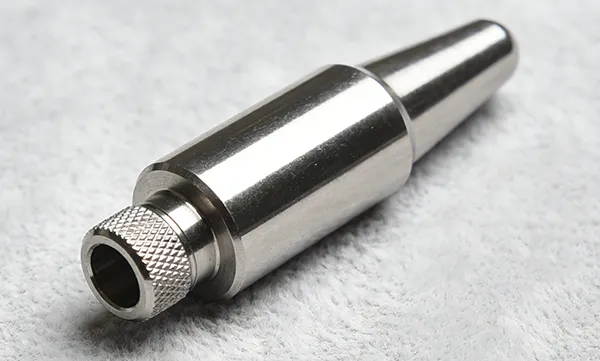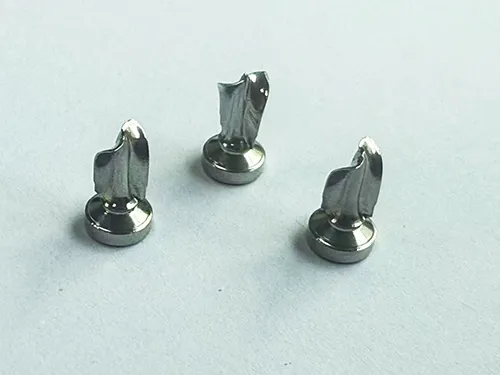
Medical Screw Machining is an essential part of the modern medical device industry, where precision fasteners like medical screws play a critical role in orthopedic implants and surgical assemblies. While standard wood screws are mass-produced using cost-effective cold extrusion with Q235A steel, medical-grade screws demand far superior mechanical properties.
We often utilize 1Cr18Ni9Ti (303/321 series) stainless steel for these components due to its exceptional acid and alkali resistance and biocompatibility. However, these specialized materials, combined with the requirement for small-batch customization, make traditional cold extrusion economically unviable and technically challenging.
The Manufacturing Dilemma: Material and Rigidity
Manufacturing medical screws involves overcoming two primary hurdles: Material Hardness and Structural Fragility.
1.Work Hardening of 1Cr18Ni9Ti:
This austenite stainless steel is notorious for high plasticity and severe work hardening during cutting. High cutting temperatures often lead to the formation of built-up edges (BUE), which can degrade surface integrity and accelerate tool wear.
2.Low Structural Rigidity:
Medical screws typically feature a small diameter (e.g., 6mm) relative to a long pitch (e.g., 2.5mm) and total length (55mm). In a standard CNC lathe setup, the radial cutting force increases significantly as the tool plunges deeper into the thread profile. For slender parts, this imbalance leads to vibration, bending, and permanent deformation.
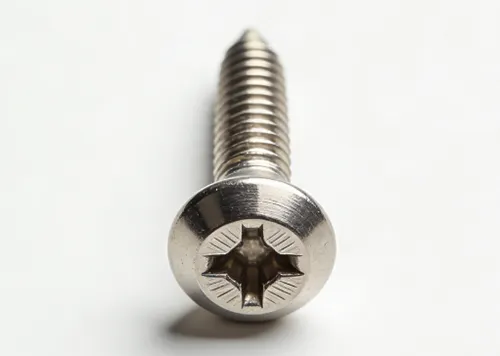
Innovative Engineering: The CNC Macro Programming Approach
To bridge the gap between low-cost mass production and high-precision customization in Medical Screw Machining, we implemented a Macro-Programmed Trajectory Synthesis method.
Instead of using traditional thread-forming tools that engage the entire thread flank at once, we utilize a 35° Carbide Coated Profiling Tool. By developing a custom CNC macro program (compatible with FANUC 0i systems), we control the tool tip to follow the exact geometric path of the thread profile in incremental layers, a key breakthrough for precise Medical Screw Machining.
The Physics of Constant Cutting Force
By calculating the optimal spindle speed ($v = \pi Dn / 1000$) and utilizing layered feed movements, the contact area between the tool and the workpiece remains constant. Unlike conventional turning where resistance spikes with depth, our method keeps the cutting force stable and minimal. This “scanning” approach effectively eliminates the risk of the screw snapping or warping under high stress, ensuring reliability in Medical Screw Machining.
Enhanced Stability with Custom Support Fixtures
Even with optimized toolpaths, the inherent flexibility of a 55mm-long screw requires external stabilization. We designed a specialized Steady Rest Support Fixture integrated into the machine’s tailstock.
Material Choice: The support sleeve is crafted from HT200 Gray Cast Iron, selected for its low friction coefficient and excellent vibration-damping properties.
Operational Logic: The fixture travels with the tailstock, providing continuous 360-degree radial support to the 6mm outer diameter. This setup neutralizes the radial component of the cutting force, ensuring that the axial straightness of the screw is maintained within a 0.04mm tolerance.
Process Optimization and Quality Assurance
Our optimized workflow involves a “Dual-Part Integrated” strategy to maximize material efficiency and setup stability. The process includes:
- Initial Turning: Machining the 6mm and 11mm diameters with a center-hole process head.
- Thread Cutting: Utilizing the macro-layered approach while supported by the HT200 fixture.
- Secondary Operations: Precise cutoff, length leveling, and slotting via a horizontal milling machine.
The final inspection confirms a surface roughness of Ra 3.2μm, meeting the stringent requirements for medical implants.
Conclusion
By combining advanced CNC Macro Programming with innovative Fixture Engineering, we have established a robust framework for producing high-toughness, small-batch medical components.
This integrated approach not only addresses the core challenges of Medical Screw Machining—balancing cost-effectiveness, precision, and structural integrity—but also sets a new standard for small-batch production of medical implants.
The macro-programmed layered cutting method, paired with the custom HT200 steady rest fixture, ensures consistent quality control, meeting the strict biocompatibility and dimensional accuracy requirements of medical devices. Furthermore, this framework is highly adaptable, allowing for rapid adjustments to accommodate different screw specifications and design modifications, which is critical in the dynamic field of medical device manufacturing.
Aerospace Parts Aluminum Alloy Machining CNC machining Hearing aid parts Inconel Laryngoscope LFP Batteries Medical parts processing Medical Screw Machining pacemaker Rolling Bearing Semiconductor components Shaft Core slip ring Stainless Steel Titanium