Laryngoscope Components: An Overview
Laryngoscopes are critical airway management devices used to provide visibility and access during intubation. Their performance depends not only on the overall device design, but also on the dimensional accuracy, material selection, surface finish and assembly fit of individual components.
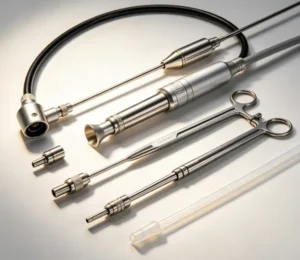
Common laryngoscope components include blades, handles, blade-to-handle connectors, locking mechanisms, pins, springs, light-guide housings and electrical contacts. Each component has different mechanical, dimensional and manufacturing requirements.
For medical device manufacturers, choosing the right manufacturing process is essential when developing these components. Precision CNC machining can produce complex metal and engineering-plastic parts with controlled dimensions, repeatable geometry and consistent surface finishes.
Sunpower Manufacturing provides custom precision CNC machining for medical device components, supporting prototype development and production of precision parts according to customer drawings, specifications and inspection requirements.

I.What Are the Main Laryngoscope Components?
A laryngoscope is made up of multiple components that work together as a mechanical, optical and, in some designs, electrical system. The exact configuration varies between conventional, reusable, disposable and video laryngoscopes.
| Component | Function | Common Materials | Manufacturing Focus |
|---|---|---|---|
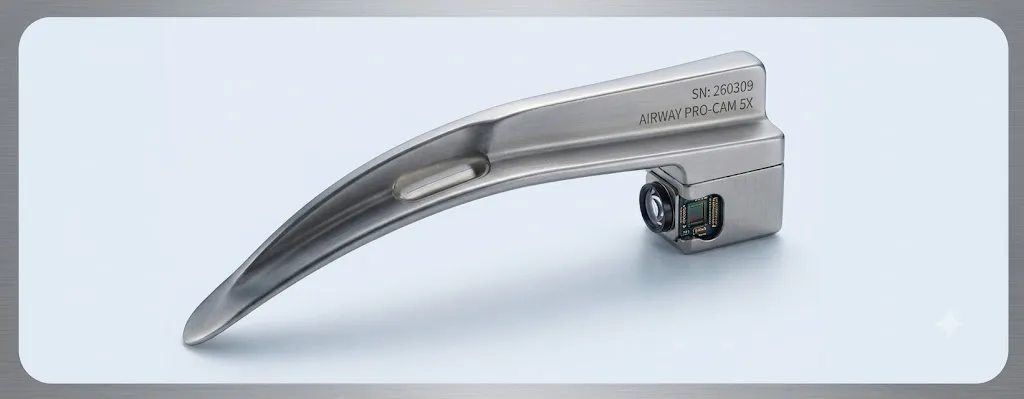
| Laryngoscope Blade | Provides access and lifts the epiglottis | 316L / stainless steel | Forming, CNC machining, polishing |
| Handle Housing | Houses battery/electronics and provides grip | Aluminum / stainless steel | CNC milling, knurling |
| Blade Connector | Connects blade to handle | 17-4 PH / 316L | Tight tolerances |
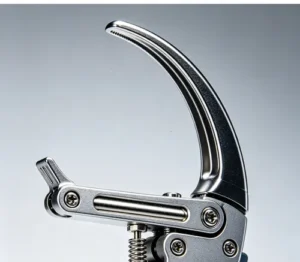
| Locking Hook & Pin | Secures blade to handle | Stainless steel | Precision machining |
| Light Guide Housing | Positions light transmission components | Stainless steel / PEEK | Micro-machining |
| Electrical Contacts | Transfers electrical power | Copper alloys / plated materials | Contact geometry |
| Springs / Detents | Provides locking and return force | Spring stainless steel | Forming / heat treatment |
The manufacturing requirements of these parts are not identical. A blade may require controlled curvature and edge finishing, while a locking pin may depend more heavily on diameter, concentricity and wear resistance.
For this reason, laryngoscope component manufacturing should begin with the functional requirements of each individual part rather than applying the same machining strategy to every component.
Types of Laryngoscope Components
Reusable Laryngoscope Components
Reusable laryngoscopes are designed to withstand repeated cleaning, disinfection and, depending on the device and validated instructions, sterilization cycles.
Their metal components therefore require careful material selection and surface finishing. Stainless steel and other corrosion-resistant materials are commonly considered for structural and mechanical parts where durability and repeated processing are important.
For reusable components, manufacturers should consider:
- Corrosion resistance
- Mechanical strength
- Dimensional stability
- Surface condition
- Deburring
- Cleaning requirements
- Compatibility with the device’s validated reprocessing method
Disposable Laryngoscope Components
Disposable laryngoscopes and components may use a different combination of metals and engineering polymers to balance manufacturing cost, weight and functional requirements.
Components may include molded polymer housings, metal inserts, connectors, blades and small precision-machined parts.
For disposable products, manufacturing consistency is particularly important because large production volumes require repeatable dimensions and stable assembly performance.
Video Laryngoscope Components
Video laryngoscopes incorporate additional optical, imaging and electronic elements compared with conventional direct laryngoscopes.
Depending on the device architecture, these may include:
- Camera housings
- Light-guide components
- Optical channels
- Blade structures
- Handle housings
- Electrical contacts
- Connectors
- Precision mounting components
CNC machining can be used for selected metal and engineering-plastic components where accurate alignment, controlled geometry and repeatable assembly are required.
Conventional Direct Laryngoscope Components
Traditional direct laryngoscopes generally rely on a blade-and-handle configuration with mechanical and illumination components.
The blade-to-handle interface is especially important because dimensional variation can affect assembly fit and locking behavior.

Ⅱ. Materials Used for Laryngoscope Components
Material selection depends on the component’s function, mechanical requirements, environmental exposure, manufacturing process and applicable device specifications.
316L Stainless Steel
316L stainless steel offers good corrosion resistance and is suitable for many precision medical components, including:
- Laryngoscope blades
- Connectors
- Pins
- Housings
- Structural components
It can also be processed using common machining and finishing methods.
17-4 PH Stainless Steel
17-4 PH stainless steel provides high strength and hardness after appropriate heat treatment. It can be used for components exposed to repeated mechanical loads, such as:
- Locking hooks
- Pins
- Detents
- Shafts
- Mechanical interfaces
The required material condition and heat treatment should follow the engineering specification.
Titanium Alloys
Titanium alloys provide a high strength-to-weight ratio and good corrosion resistance, making them useful where weight reduction or specific mechanical properties are required.
MRI compatibility should not be assumed from material selection alone. The complete device design must be evaluated for the intended environment.
PEEK and Engineering Polymers
PEEK and other engineering polymers can be used for selected lightweight, insulating or structural components, including:
- Bushings
- Spacers
- Insulating parts
- Handle elements
Material selection should consider temperature, chemical exposure, mechanical loading and cleaning or sterilization requirements.
Ⅲ. CNC Machining for Laryngoscope Components
Precision CNC machining can produce laryngoscope components with controlled dimensions, holes, threads, curved surfaces and mating features.
Depending on the part geometry, common manufacturing processes include:
- CNC milling
- CNC turning
- Swiss-type machining
- Multi-axis machining
- Grinding
- EDM
- Secondary finishing
CNC Milling
CNC milling is suitable for blades, housings, connector bodies, mounting components and other complex geometries. Multi-axis machining can reduce setups and improve positional accuracy between critical features.
CNC Turning
CNC turning and Swiss-type machining are well suited to small precision components such as pins, shafts, bushings, spacers and threaded parts.
Grinding and Secondary Finishing
Grinding can be used when tighter dimensional control or a specific surface finish is required. Depending on the material and application, secondary processes may include:
- Deburring
- Polishing
- Passivation
- Anodizing
- Plating
- Precision cleaning
The finishing process should be specified according to the material, drawing and final application.
Dimensional Accuracy and Surface Finish
Dimensional control is particularly important at laryngoscope component interfaces, such as blade-to-handle connections, locking mechanisms and light-guide assemblies.
Important characteristics may include:
- Dimensional tolerances
- Positional tolerances
- Concentricity
- Flatness
- Hole and thread dimensions
- Surface roughness
- Edge condition
- Burr control
Critical tolerances should be defined according to the engineering drawing and functional requirements rather than applying one tolerance to every feature.
Sunpower Manufacturing supports high-precision CNC machining and CMM inspection for demanding components. Achievable tolerances depend on the part geometry, material, machining process and customer drawing requirements.
Surface Finish and Deburring
Proper surface finishing helps maintain component fit, handling quality and cleanability.
Depending on the component, manufacturing controls may include:
- Edge breaking
- Precision deburring
- Controlled surface roughness
- Polishing
- Passivation for applicable stainless steel parts
- Final cleaning
Surface-finish requirements should be specified according to the component’s function, material and device design rather than treated as a universal value.
Ⅳ. Quality Control for Laryngoscope Components
Quality control should begin before machining and continue through final inspection.
Raw Material Control
Raw material verification can include:
- Material Test Reports (MTR)
- Heat or lot identification
- Chemical composition verification where required
- Material traceability
- Incoming inspection
For critical medical components, maintaining material traceability can help manufacturers and customers understand the origin and processing history of the material used in production.
In-Process Inspection
During machining, critical dimensions can be monitored using appropriate inspection equipment and methods.
Depending on the component, this may include:
- Coordinate Measuring Machine (CMM) inspection
- Optical measurement
- Calipers and micrometers
- Thread gauges
- Pin gauges
- Surface roughness measurement
- First Article Inspection (FAI)
- Statistical Process Control (SPC)
The inspection method should correspond to the dimensional and functional requirements of the component.
Final Inspection
Final inspection may verify:
- Critical dimensions
- Geometric tolerances
- Threads
- Hole locations
- Mating features
- Surface finish
- Burrs and sharp edges
- Surface treatment
- Visual appearance
- Quantity and packaging
For customer-specific projects, inspection reports and material documentation can be supplied according to the agreed quality requirements.
Ⅴ. Common Laryngoscope Component Manufacturing Problems
1. Incorrect Material Selection
Selecting a material without considering corrosion resistance, mechanical loading, temperature exposure and cleaning or sterilization requirements can create problems later in the product lifecycle.
Better approach: Define material requirements before machining and verify the selected material against the engineering specification.
2. Poor Deburring and Edge Control
Machining burrs can interfere with assembly, affect surface quality and create unwanted sharp edges.
Better approach: Include deburring and edge-condition requirements directly in the drawing or manufacturing specification.
3. Loose Tolerances at Locking Interfaces
The blade-to-handle connection may depend on several interacting dimensions.
Excessive dimensional variation can contribute to poor fit, unwanted movement or inconsistent assembly.
Better approach: Identify critical mating dimensions and inspect them using appropriate measurement equipment.
4. Inconsistent Light-Guide Alignment
For components used with illumination or optical systems, incorrect positioning or geometry can affect the relationship between the light source, guide and distal end.
Better approach: Control critical alignment dimensions and inspect the relevant interfaces during production.
5. Inadequate Surface Treatment
Stainless steel components may require an appropriate post-machining treatment depending on the material, application and customer specification.
Better approach: Define the required surface treatment, cleaning process and inspection criteria before production.
6. Designing the Component Without Considering Manufacturing
A component may function well in a CAD model but become unnecessarily expensive or difficult to manufacture because of inaccessible features, excessive tolerances or complex setups.
Better approach: Review the design for manufacturability before production.
A DFM review can identify:
- Unnecessary tight tolerances
- Difficult-to-machine internal features
- Excessive setups
- Thin walls
- Deep narrow cavities
- Difficult-to-measure dimensions
- Unnecessary surface requirements
Aerospace Parts Aluminum Alloy Machining CNC machining Hearing aid parts Inconel Laryngoscope LFP Batteries Medical parts processing Medical Screw Machining pacemaker Rolling Bearing Semiconductor components Shaft Core slip ring Stainless Steel Titanium